


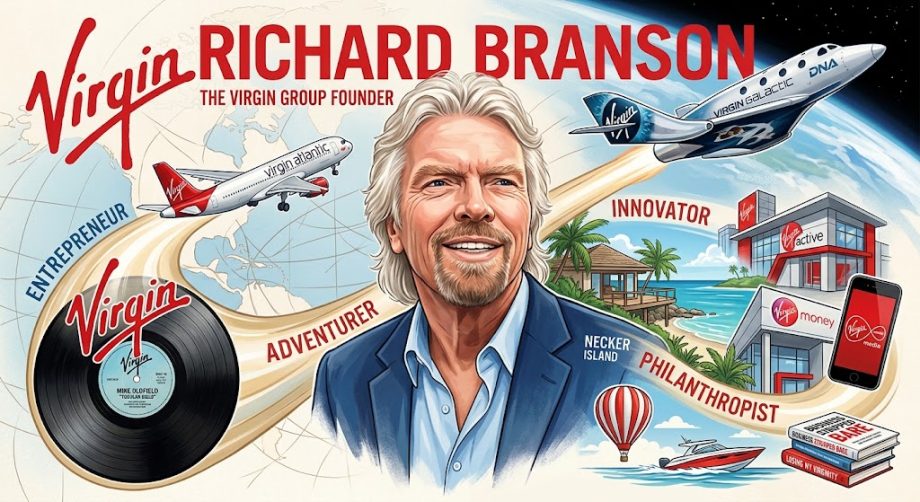
Richard Branson is a British entrepreneur best known as the founder of the Virgin Group, a business empire spanning airlines, music, mobile telecommunications, health, and commercial space travel. Born in 1950 in Blackheath, London, Branson built his fortune from a single mail-order record business into a network of hundreds of companies operating in dozens of countries. He is equally known for his adventurous public image, his struggles with dyslexia, and his outspoken views on business and philanthropy.
Who Is Richard Branson and What Made Him Famous?
Richard Branson is the founder of Virgin Group, a company he built from a student magazine into a global conglomerate touching air travel, music, mobile phones, and space tourism. Born Richard Charles Nicholas Branson on July 18, 1950, he grew up in Surrey, England, the son of a barrister father and a mother who worked as a flight attendant and later ran her own small businesses. He struggled academically because of dyslexia, a learning difference that affects reading and language processing, and left school at 16 to pursue business ventures full time.
Branson’s public fame grew alongside Virgin’s expansion. He became known for personally promoting his companies through stunts, record attempts, and media appearances, including hot air balloon crossings of the Atlantic and Pacific Oceans in the 1980s and 1990s. This hands-on, high-visibility style of leadership set him apart from more conventional corporate executives and helped Virgin’s brand become recognizable well beyond the products it actually sold.
Early Life and the Roots of Virgin
Branson’s first venture was Student magazine, which he launched at age 16 while still in school, using it to interview public figures and sell advertising. The venture taught him early lessons in negotiation and cash flow management that he later applied across every Virgin business. In 1970, he used the magazine’s mailing list to start a mail-order record business, selling discounted records to young readers.
That record business evolved into a physical record shop on Oxford Street in London, and by 1972 Branson had opened a recording studio in Oxfordshire called The Manor. The studio’s first release, Mike Oldfield’s “Tubular Bells” in 1973, became a massive commercial success and gave Branson the capital to expand Virgin Records into a full-fledged label.
What Is Virgin Group and How Many Companies Does It Include?
Virgin Group is the parent company that houses Branson’s business interests, structured as a branding and investment umbrella rather than a single unified corporation. Rather than owning and operating every business directly, Virgin typically holds a stake, licenses the Virgin name, and partners with other investors or operators. This structure has allowed the brand to expand into industries as varied as banking, fitness, and space travel without requiring Branson to personally manage each one.
Estimates of the number of companies under the Virgin umbrella commonly range into the hundreds, though the exact count shifts as businesses launch, merge, or close. The businesses share the red Virgin logo and a customer-facing tone that emphasizes value and a bit of irreverence, but they operate with largely independent management teams and separate ownership structures.
Virgin Records and the Music Industry
Virgin Records became one of the most influential independent labels of the 1970s and 1980s, signing acts including the Sex Pistols and Culture Club during a period when major labels were reluctant to work with punk and new wave artists. The label’s willingness to take on controversial acts, including the Sex Pistols after other labels dropped them, became part of Virgin’s brand identity as a company willing to bet on outsiders. Branson sold Virgin Records to EMI in 1992 for roughly $1 billion, a deal that provided capital he reinvested into Virgin Atlantic Airways during a difficult period for the airline.
Virgin Atlantic and the Airline Business
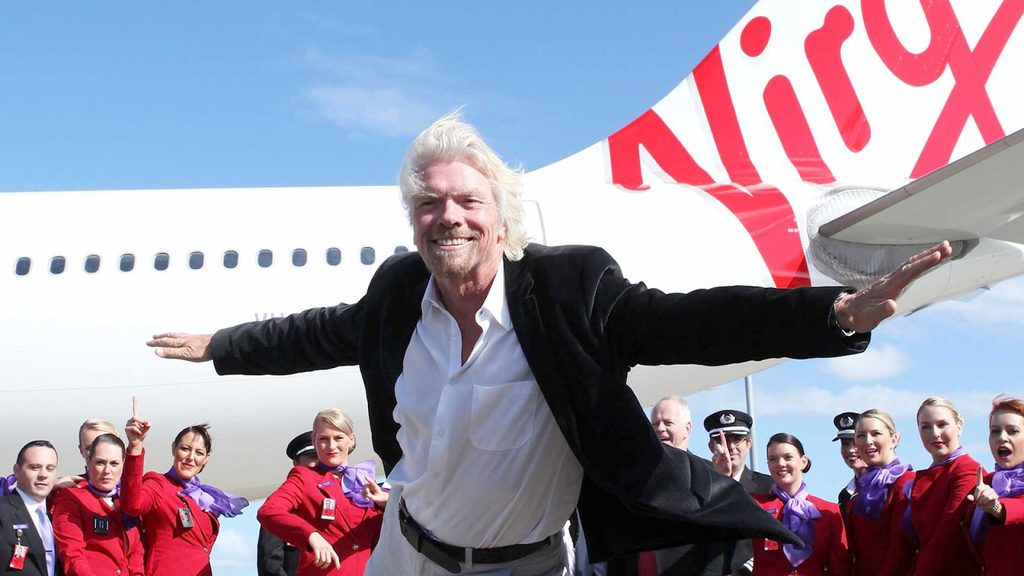
Branson founded Virgin Atlantic Airways in 1984, entering an industry dominated by established national carriers and taking on significant financial risk with a single leased Boeing 747. The airline positioned itself around better customer service and amenities than competitors offered at the time, including onboard entertainment systems and upgraded seating, at a moment when transatlantic flying was still relatively utilitarian. Virgin Atlantic survived early competitive pressure from British Airways, including a legal dispute over corporate conduct that Virgin won, and it remains one of the most recognized brands to emerge from the Virgin portfolio.
Virgin Galactic and Commercial Space Travel
Virgin Galactic is Branson’s venture into commercial human spaceflight, aiming to bring paying passengers to the edge of space aboard a purpose-built spaceplane rather than a traditional rocket. The company was founded in 2004 and spent roughly two decades in development and testing before beginning commercial passenger flights. Branson flew aboard Virgin Galactic’s VSS Unity in July 2021, becoming one of the first company founders to travel to the edge of space on a vehicle built by his own company, narrowly ahead of a similar flight by Amazon founder Jeff Bezos on a Blue Origin rocket.
What Is Richard Branson’s Net Worth?
Richard Branson’s net worth is commonly estimated in the billions of dollars by financial publications such as Forbes, though the exact figure fluctuates significantly because much of his wealth is tied to the value of Virgin companies and their public share prices rather than cash holdings. Virgin Galactic in particular has been a volatile factor in these estimates, since its stock price has swung considerably since the company went public in 2019, directly affecting how outlets calculate Branson’s overall wealth at any given moment. Because of this volatility, any single number should be treated as a snapshot rather than a fixed figure, and readers looking for a current estimate should check an outlet’s real-time billionaire tracker rather than relying on a figure that may already be outdated.
Much of Branson’s wealth is illiquid, meaning it is held in business ownership stakes and property rather than readily available cash. His most visible personal asset is Necker Island, a private island in the British Virgin Islands that he purchased in the late 1970s and later developed into a luxury retreat that also serves as his primary residence.
What Is Richard Branson’s Business Philosophy?
Branson has consistently described his approach to business as one centered on people first, profit second, arguing that companies perform better financially when employees and customers are treated well. He has written and spoken extensively about this idea, framing traditional shareholder-first thinking as short-sighted compared to building loyalty among staff and customers over the long term. This philosophy shows up in Virgin’s consistent emphasis on customer service as a competitive advantage, even in industries like airlines and mobile phone service where price is often the primary differentiator.
He has also been vocal about learning from failure, pointing to unsuccessful ventures such as Virgin Cola and Virgin Brides as necessary costs of an experimental approach to business. Rather than treating these failures as embarrassments, Branson has folded them into his public narrative as evidence that risk-taking, even when it does not pay off, is central to how Virgin operates.
Common Misconceptions About Richard Branson
One common misconception is that Branson personally owns and runs every Virgin-branded business, when in practice most operate as separate companies with their own management and often outside investors holding significant stakes. Another is that his wealth is primarily inherited or came from a single lucky break, when his financial history actually shows a pattern of reinvesting proceeds from one venture, such as the sale of Virgin Records, into building the next one, such as Virgin Atlantic. A third misconception involves his education: Branson’s struggles with dyslexia and decision to leave school at 16 are sometimes framed as proof that formal education is unnecessary for success, though Branson himself has spoken about the specific accommodations, family support, and financial risk-taking that made his path possible, factors not every young entrepreneur has access to.
Conclusion
Richard Branson built the Virgin Group from a single mail-order record business into a global portfolio spanning music, aviation, and commercial space travel, driven by a consistent philosophy of prioritizing customer experience and treating failure as a normal cost of taking risks. His net worth remains tied closely to the performance of Virgin Galactic and other public holdings, which is why estimates vary and change frequently. Readers interested in learning more may want to explore the history of Virgin Atlantic’s rivalry with British Airways or the broader development of commercial space tourism alongside competitors like Blue Origin and SpaceX.
