



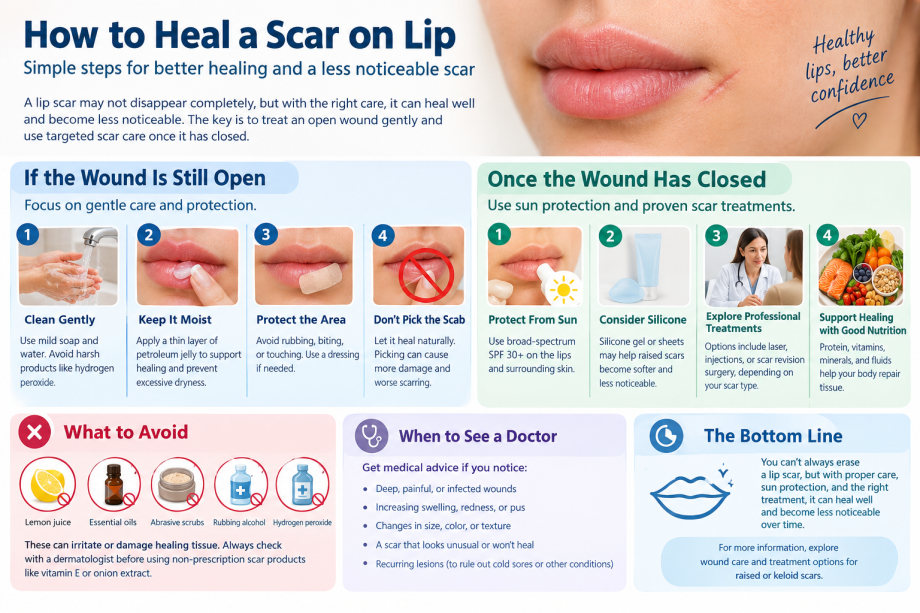
A lip scar usually cannot be erased completely, but proper care can help it heal well and become less noticeable over time. If the injury is still open, gently clean it, keep it moist with petroleum jelly, and protect it while it heals. Once the wound has closed, sun protection and appropriate scar treatments may improve its appearance. Raised, painful, unusually changing, or persistent scars should be evaluated by a healthcare professional.
What Causes a Scar on the Lip?
A lip scar forms when an injury damages deeper layers of tissue and the body repairs the area with new collagen.
Cuts, bites, burns, accidents, surgery, piercings, acne-related injuries, and other trauma can all potentially leave a scar. The depth and size of the original injury have a major influence on the final appearance. According to the American Academy of Dermatology (AAD), scars form when an injury reaches the deeper dermis, causing the body to produce collagen to repair the damage.
The location of a lip injury can make healing particularly noticeable because the lips move constantly while talking, eating, drinking, and making facial expressions. The area can also be exposed to saliva, food, cosmetics, sunlight, and repeated touching.
Not every mark on the lip is actually a permanent scar. Redness, discoloration, swelling, dryness, or a healing crust can temporarily make an injury look worse than the final scar will appear.
What Does a New Lip Scar Look Like?
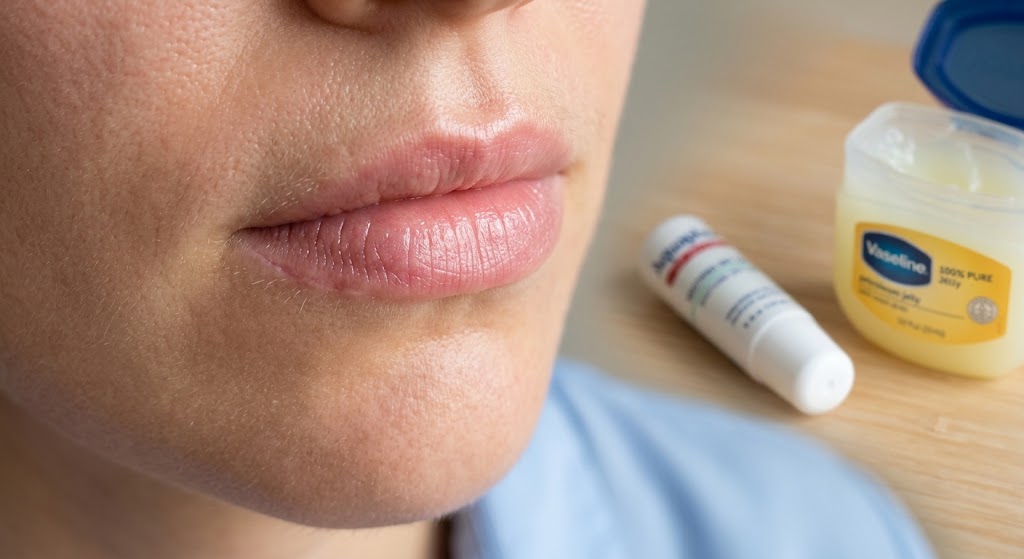
A new scar may appear pink, red, darker, lighter, slightly raised, or somewhat uneven.
As the scar matures, its color and texture can change. The AAD explains that new scars commonly appear pink or reddish and may gradually become lighter or darker as they mature.
This means a scar that looks prominent shortly after an injury may become considerably less noticeable later. The healing process can take months, and the final appearance varies from person to person.
How to Heal a Scar on Lip While the Wound Is Still Open
If the injury has not completely closed, wound care should come before scar treatment.
Trying to treat an open wound with aggressive scar products, exfoliants, acids, or cosmetic procedures can irritate the tissue and interfere with normal healing. The goal at this stage is to keep the wound clean, protected, and appropriately moist.
1. Gently Clean the Injury
Wash the injured area gently with clean water and mild soap when appropriate for the location of the wound.
Do not scrub the injury or repeatedly disturb developing tissue. Gentle cleaning helps remove dirt and debris while avoiding unnecessary trauma.
The AAD recommends cleaning minor wounds with soap and water and specifically advises against hydrogen peroxide because it can damage skin.
2. Keep the Wound Moist
A thin layer of plain petroleum jelly can help keep a minor wound moist while it heals.
Allowing an injury to become excessively dry and form a thick scab can prolong healing. The AAD recommends petroleum jelly for minor wounds because keeping the wound moist can help it heal and may reduce the eventual size, depth, and itchiness of a scar.
For a wound on the outside of the lip, apply products only as directed and avoid getting non-food-safe products inside the mouth.
3. Protect the Area
A healing injury should be protected from unnecessary rubbing, picking, biting, and repeated touching.
If the injury is on the skin immediately around the mouth, an appropriate dressing may help protect it. Injuries involving the actual wet inner surface of the lip may require different care, particularly if they are deep or contaminated.
Do not repeatedly pull away scabs or healing tissue simply to see how the injury looks. Disturbing the area can cause additional inflammation and potentially worsen scarring.
4. Do Not Pick the Scab
Picking at a healing lip injury can cause additional tissue damage.
A scab is part of the body’s natural repair process. Removing it prematurely can reopen the wound and create another opportunity for inflammation or infection.
If the area feels dry or uncomfortable, appropriate wound care is preferable to scratching, peeling, biting, or picking.
How to Heal a Scar on Lip After the Wound Has Closed
Once the wound has completely closed, the focus can shift from wound care to scar management.
A closed scar is different from an open cut. At this stage, protecting the scar from sunlight and discussing suitable scar treatments can help improve its appearance over time.
Protect the Scar From Sun Exposure
Sun protection is one of the most useful long-term steps for a healed lip scar.
Ultraviolet exposure can make scar discoloration more noticeable. The AAD recommends broad-spectrum sunscreen with SPF 30 or higher for exposed scars after the wound has healed.
Because the lips are frequently exposed to sunlight, a lip product with appropriate broad-spectrum SPF can be useful for the lip itself. The AAD recommends SPF 30 or higher for lip protection and advises reapplication when outdoors.
Avoid putting ordinary sunscreen inside the mouth. Products intended specifically for the lips should be used on the lip surface according to their instructions.
Consider Silicone for Certain Scars
Silicone gel or silicone sheets may be useful for some raised scars after the wound has closed.
The AAD reports that silicone can help raised scars become smaller, softer, less red, less swollen, less itchy, or less stiff. Silicone sheets may work better than silicone ointment in some circumstances.
However, a silicone product must be appropriate for the location and type of scar. A product designed for external skin should not automatically be applied to the moist inner surface of the mouth.
If the scar is directly on the lip border or in an area that moves frequently, ask a dermatologist or other qualified healthcare professional which formulation is appropriate.
Can a Lip Scar Go Away Completely?
Most scars become less noticeable, but no treatment can guarantee that a scar will disappear completely.
The AAD explains that many scars naturally fade over time, while certain types, including keloids and some depressed scars, may not disappear without treatment.
Several factors influence the final appearance, including the original depth of the wound, its location, wound care, genetics, age, skin characteristics, and whether the scar becomes raised or depressed.
A small, shallow cut may eventually leave only a faint line. A deep cut that crosses the lip border may remain more visible because it has damaged deeper tissue and lies in an area that moves frequently.
What Treatments Can a Dermatologist Use for a Lip Scar?
A dermatologist can identify the type of scar and choose treatment according to its appearance, age, location, and symptoms.
There is no single scar treatment that works for every person. The AAD notes that different scar types require different treatments and that a dermatologist should assess the scar before treatment.
Possible professional treatments include:
Silicone Treatment
Silicone gel or sheets may be considered for raised scars after the wound has closed.
Treatment generally requires consistent use over time rather than a single application. Silicone can sometimes cause skin irritation or breakdown, so treatment should be stopped and assessed if significant irritation develops.
Laser or Light Treatment
Certain laser and light treatments can reduce redness, discoloration, texture, and other visible features of some scars.
These treatments are selected according to the type and characteristics of the scar. The AAD notes that laser or light therapy can be used for several scar concerns, including redness and certain raised or depressed scars.
Because the lip is a sensitive and highly visible area, professional assessment is particularly important before cosmetic laser treatment.
Corticosteroid Injections
Raised scars and keloids may sometimes be treated with corticosteroid injections.
These medications are injected directly into the scar and can reduce its size and symptoms such as itching or pain. The AAD reports that multiple treatments are often needed and that side effects can include skin thinning and changes in pigmentation.
This treatment should only be performed by an appropriately qualified healthcare professional.
Scar Revision Surgery
Some scars may be improved through surgical scar revision.
Surgery does not guarantee that a scar will disappear, because the procedure itself creates a new wound. It may nevertheless be considered when a scar is significantly visible, distorted, restrictive, or otherwise difficult to manage with less invasive approaches.
A dermatologist or plastic surgeon can determine whether scar revision is appropriate.
What Should You Avoid Putting on a Lip Scar?
Avoid harsh or irritating substances, especially while the wound is healing.
Common home remedies are not automatically safe simply because they are natural. Lemon juice, undiluted essential oils, abrasive scrubs, strong acids, rubbing alcohol, and hydrogen peroxide can irritate or damage healing tissue.
The AAD specifically recommends avoiding hydrogen peroxide when caring for wounds because it can further damage the skin.
The same principle applies to lip products. If a product causes burning, stinging, or irritation, discontinue it rather than assuming that the sensation means the product is working. The AAD recommends avoiding irritating ingredients when lips are damaged or chapped.
Be Careful With Vitamin E and Other Scar Remedies
Vitamin E, onion extract, vitamin A, and other non-prescription scar products are widely marketed for scar improvement.
However, evidence for some of these products is limited. The AAD recommends discussing non-prescription scar treatments with a dermatologist before using them.
This is particularly relevant to the lip because the product may accidentally enter the mouth or irritate sensitive tissue.
How Long Does a Lip Scar Take to Heal?
A lip wound may close relatively quickly, but the scar can continue changing for much longer.
The initial wound-healing phase and scar-maturation phase are different processes. A wound may appear closed while the underlying scar is still remodeling.
During maturation, a scar can gradually become flatter, softer, lighter, or otherwise less noticeable. The exact timeline depends on the injury and the individual.
A scar that remains somewhat red or firm during the early healing period does not necessarily represent its final appearance.
Can Food or Nutrition Help a Lip Scar Heal?
Adequate nutrition supports normal wound healing, although no particular food can erase an established scar.
The body requires adequate energy, protein, vitamins, minerals, and fluids to repair damaged tissue. A balanced diet containing protein-rich foods, fruits, vegetables, whole grains, and other nutrient-dense foods can support general healing.
If someone has a restricted diet, poor appetite, significant weight loss, or another reason to suspect nutritional deficiency, a healthcare professional can provide individualized advice.
Nutrition should complement proper wound care rather than replace it.
When Should You See a Doctor About a Lip Scar?
A healthcare professional should evaluate a lip injury when it is deep, unusually painful, infected, or unlikely to heal normally.
Seek medical attention for a wound with signs such as worsening pain, increasing swelling, warmth, pus or other concerning drainage, or fever. These can indicate infection.
A deep facial wound may also require professional treatment, and some wounds benefit from appropriate closure to reduce the resulting scar. The AAD notes that stitches may help minimize scarring when they are needed.
You should also seek professional assessment if the injury affects the shape or movement of the lip, crosses the lip border significantly, or was caused by a serious accident or animal or human bite.
When Should a Persistent Lip Scar Be Checked?
A scar that changes unexpectedly or appears without a known injury deserves medical evaluation.
The AAD notes that some skin cancers can resemble scars and recommends evaluation when a person develops a scar-like area without remembering an injury.
A persistent lesion that bleeds, repeatedly develops a crust, grows, changes color, becomes painful, or does not behave like a normal healing scar should not simply be treated as a cosmetic problem.
Professional evaluation is especially useful when you are uncertain whether you are looking at a scar, cold sore, infection, cyst, irritated skin, or another condition.
What Is the Difference Between a Scar and a Cold Sore?
A scar is the result of tissue repair after an injury, while a cold sore is caused by herpes simplex virus.
A cold sore typically develops as a cluster of fluid-filled blisters that later break, crust, and heal. A scar, by contrast, generally remains as a change in texture or color after an injury has healed.
If a recurring lip lesion repeatedly appears in approximately the same location, particularly with tingling or blistering beforehand, it may not be an ordinary scar.
Do not assume that every mark on the lip is a scar. A healthcare professional can help distinguish between different causes when the diagnosis is uncertain.
Can You Massage a Lip Scar?
Scar massage may be recommended for some healed scars, but it is not appropriate for every lip injury.
Massage should never be performed aggressively on an open wound, recently closed wound, infected area, or painful tissue. The appropriate technique depends on the location, depth, age, and type of scar.
Because the lips are delicate and mobile, professional guidance can be helpful before starting massage, particularly after surgery or a deep injury.
A Simple Lip Scar Care Routine
A simple routine can help protect a healing lip injury without exposing it to unnecessary irritation.
- Keep the area clean. Gently clean a minor wound and remove visible debris without scrubbing.
- Keep the wound appropriately moist. For a minor external skin injury, petroleum jelly can help prevent excessive drying while the wound heals.
- Avoid picking and biting. Repeated trauma can interfere with healing.
- Protect the wound. Use an appropriate dressing when needed and change it as directed.
- Wait until the wound closes before using scar treatments. Scar-management products are generally intended for healed skin rather than open wounds.
- Protect the healed scar from sunlight. Use broad-spectrum SPF 30 or higher on exposed skin and appropriate SPF lip protection on the lips.
- Monitor the scar. Look for changes in size, color, texture, pain, swelling, or drainage.
- Get professional advice when necessary. Raised, painful, restrictive, unusually changing, or persistent scars may benefit from dermatological assessment.
Frequently Asked Questions About Lip Scars
Can petroleum jelly remove a lip scar?
Petroleum jelly does not remove an established scar. Its main role is to keep a minor open wound moist while it heals, which can help support proper wound healing and may reduce excessive scarring.
Can sunscreen make a lip scar fade?
Sun protection can help prevent a healed scar from becoming darker or more noticeable. It does not literally erase the scar, but consistent protection can support a less noticeable appearance over time.
Is silicone gel good for lip scars?
Silicone can help some raised scars, particularly after the wound has closed. Because the lips include both external skin and moist mucosal tissue, use should be limited to products appropriate for the specific area and guided by product instructions or professional advice.
Can an old lip scar still improve?
Yes. Some scars become less noticeable naturally as they mature, and professional treatments may improve certain established scars. The most appropriate treatment depends on whether the scar is flat, raised, depressed, discolored, painful, or restrictive.
How can I prevent a new lip injury from becoming a large scar?
Early, appropriate wound care is one of the best ways to reduce unnecessary scarring. Keeping a minor wound clean, moist, and protected, avoiding picking, and obtaining medical care when a wound is deep or severe can all support better healing.
Conclusion
Learning how to heal a scar on lip starts with recognizing whether the area is still an open wound or has already become a mature scar. For a fresh minor injury, gentle cleaning, appropriate moisture, protection, and avoiding picking can support better healing. Once the wound has closed, sun protection and selected scar treatments may make the mark less noticeable over time. Raised, painful, infected, changing, or unexplained marks should be assessed by a healthcare professional. Related topics worth exploring include proper wound care and treatment options for raised or keloid scars.