

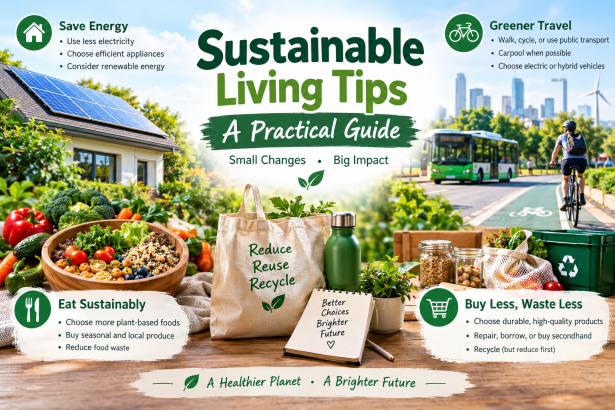


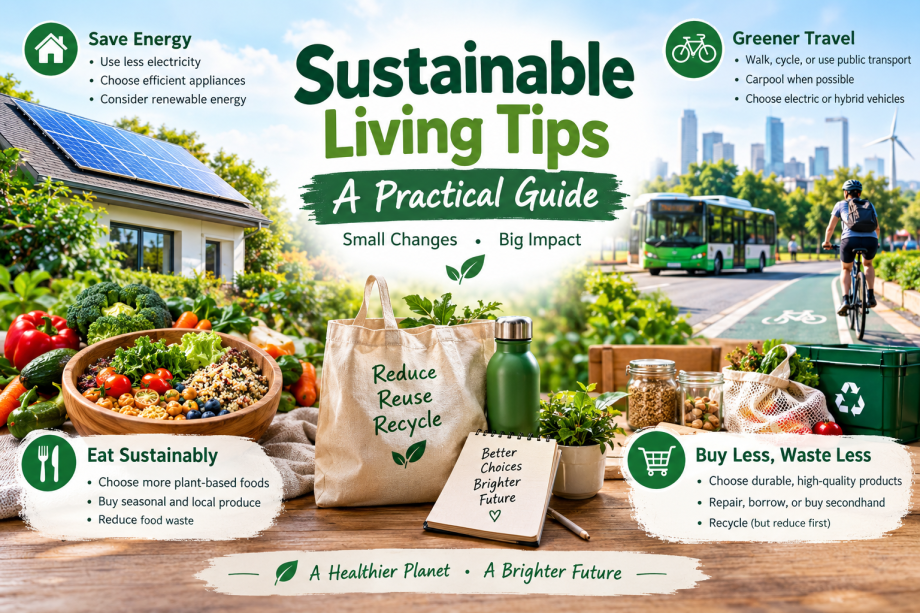
Sustainable living tips are practical habits that reduce the resources you use and the waste you create, so your daily life puts less strain on the environment. The most effective changes focus on the areas where households have the largest impact: energy use, transportation, food, and the goods you buy. Small steps all help, but prioritizing these four areas produces the biggest measurable reductions in carbon emissions, water use, and waste.
What Does Sustainable Living Mean?
Sustainable living means meeting your needs in a way that does not use up natural resources faster than they can be replenished. It covers how you power your home, how you travel, what you eat, and what you buy and throw away. The goal is a lower environmental footprint, not a perfect one.
The idea is often measured through a carbon footprint, which is the total greenhouse gas emissions linked to your activities, expressed in tonnes of carbon dioxide equivalent (CO2e). Related measures include water footprint and waste generated. Because a few activities account for most of a household’s footprint, knowing where to focus matters more than doing many minor things.
How Can You Reduce Energy Use at Home?
The quickest way to cut household energy use is to reduce heating, cooling, and electricity demand, since these make up most of a home’s consumption. Efficiency improvements usually lower both emissions and bills.
Heating and Cooling
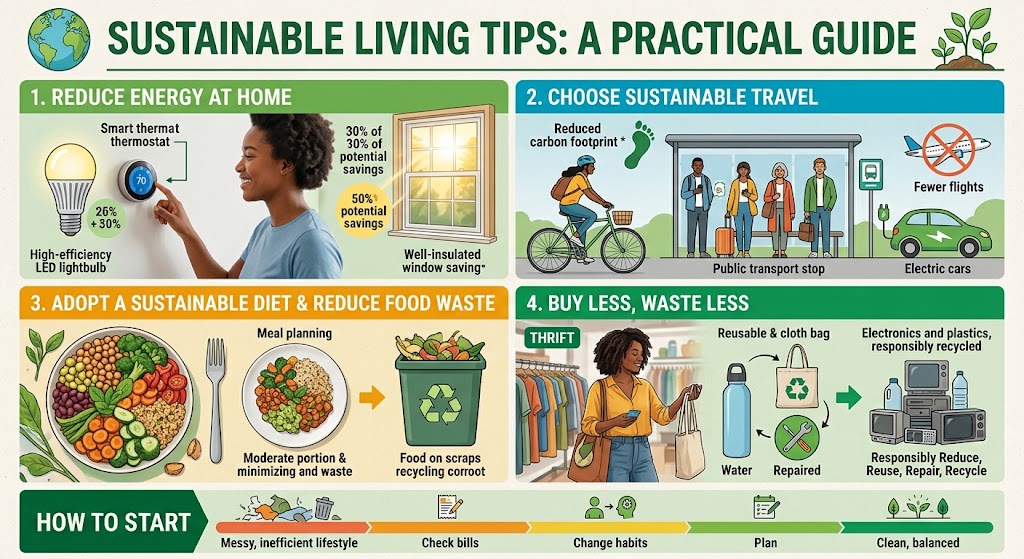
Heating and cooling together account for roughly half of the energy used in a typical US home, according to the US Energy Information Administration. Sealing gaps around doors and windows, adding insulation, and using a programmable thermostat all reduce this load. The US Department of Energy estimates that turning a thermostat back 7 to 10°F for eight hours a day can save up to 10 percent a year on heating and cooling costs.
Lighting and Appliances
Switching to LED bulbs is one of the simplest upgrades. The Department of Energy reports that LEDs use at least 75 percent less energy than incandescent bulbs and last many times longer. When replacing appliances, check efficiency ratings, and unplug devices that draw standby power, such as chargers and game consoles. Where possible, choose a renewable electricity plan or install solar panels.
How Can You Make Your Travel More Sustainable?
Choosing lower-emission ways to travel is among the most significant sustainable living tips, because transport is a major source of personal emissions. The US Environmental Protection Agency estimates that a typical passenger vehicle emits about 4.6 tonnes of CO2 per year.
Walking, cycling, and public transport produce far less per trip than driving alone. If you need a car, carpooling, keeping tires properly inflated, and eventually switching to an electric or hybrid vehicle reduce emissions. Air travel deserves special attention, as a single long-haul return flight can emit around a tonne of CO2 or more per passenger. Taking fewer, longer trips and choosing trains for shorter routes lowers that impact.
What Does a Sustainable Diet Look Like?
A sustainable diet relies more on plant-based foods and wastes as little as possible. Global food production accounts for roughly a quarter of greenhouse gas emissions, according to a widely cited 2018 analysis by Poore and Nemecek in the journal Science.
Emissions vary sharply by food. Beef is among the highest, at roughly 60 kg of CO2e per kilogram, while staples such as peas, beans, and grains produce a small fraction of that. You do not need to become vegan; replacing some meat meals with legumes, vegetables, and whole grains delivers a real reduction. Choosing seasonal and locally grown produce can also help, although how a food is produced usually matters more than how far it travels.
Reducing Food Waste
Household food waste is a large, avoidable source of emissions. The UN Environment Programme’s 2024 Food Waste Index estimated that about 1.05 billion tonnes of food were wasted worldwide in 2022, with households responsible for roughly 60 percent of it. Planning meals, storing food correctly, freezing leftovers, and composting scraps keep food out of landfills, where it releases methane.
How Can You Buy Less and Waste Less?
Reducing consumption comes first, followed by reuse and recycling. Producing new goods requires raw materials, energy, and water, so the most sustainable item is often the one you already own.
Repairing, borrowing, and buying secondhand extend the life of products. When buying new, choose durable items over cheap, short-lived ones. Reusable bags, bottles, and containers replace single-use plastic. Recycling is helpful but limited: the OECD found that only about 9 percent of plastic waste was recycled globally in 2019, so reducing use matters more than relying on recycling bins.
How Do You Start Living More Sustainably?
The easiest way to begin is to change one area at a time, starting with the habit that has the largest impact. A simple order of steps is:
- Review your energy bills and identify your biggest uses of electricity or fuel.
- Replace old bulbs with LEDs and adjust your thermostat settings.
- Choose one regular trip to switch from driving to walking, cycling, or public transport.
- Plan your meals for a week and track how much food you throw away.
- Pause before each non-essential purchase and consider repairing, borrowing, or buying secondhand instead.
- Reassess after a month and add the next habit.
What Are Common Misconceptions About Sustainable Living?
Several widespread beliefs can steer people toward low-impact actions while overlooking high-impact ones. One is that recycling alone solves waste problems, when reducing consumption has a larger effect. Another is that individual action does not matter; household choices on energy, food, and transport make up a large share of national emissions, and they also influence markets and policy. A third is that sustainable living is expensive, although many core habits, such as using less energy, wasting less food, and buying less, save money.
Perfection is also not required. Research on behavior change consistently shows that steady, realistic habits last longer than dramatic overhauls.
Conclusion
Effective sustainable living tips center on four areas: using energy efficiently, traveling with lower emissions, eating more plant-based foods while wasting less, and buying fewer, longer-lasting goods. Starting with the habits that cut the most emissions, then building gradually, produces lasting results. To keep learning, you might explore how to calculate your personal carbon footprint or how home energy audits work.