




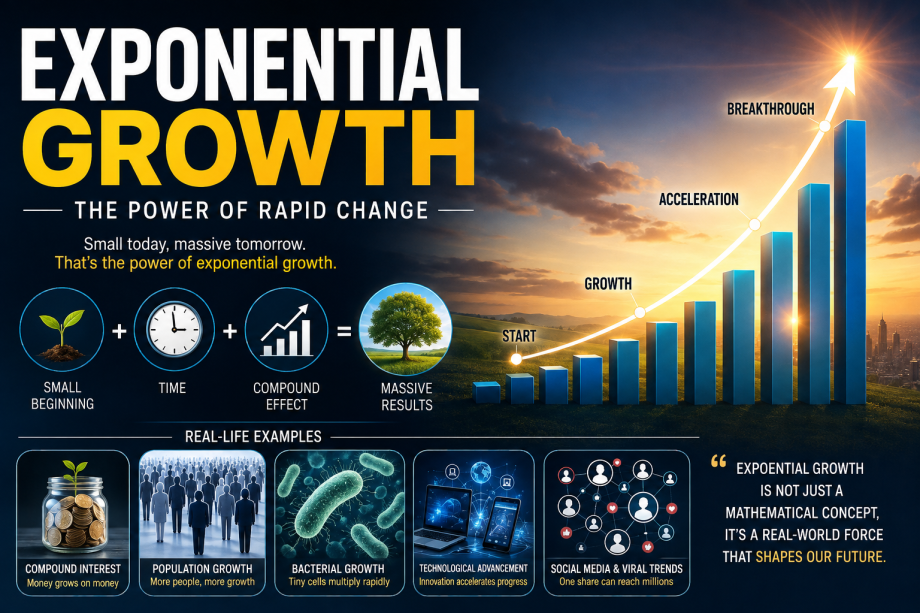
Have you ever wondered how something can seem small and unimportant one day, then suddenly become enormous? A social media trend can reach millions of people within days. A savings account can slowly build for years and then begin increasing much faster. A population of bacteria can multiply from a handful to millions in a surprisingly short period.
These situations share an important mathematical idea: exponential growth. It describes a pattern in which the amount being added depends on how much is already there. Instead of increasing by the same amount each time, the increase becomes larger as the starting quantity grows.
Understanding this concept is useful far beyond mathematics. It can help us understand money, technology, business, population changes, online trends, science, and even everyday decision-making.
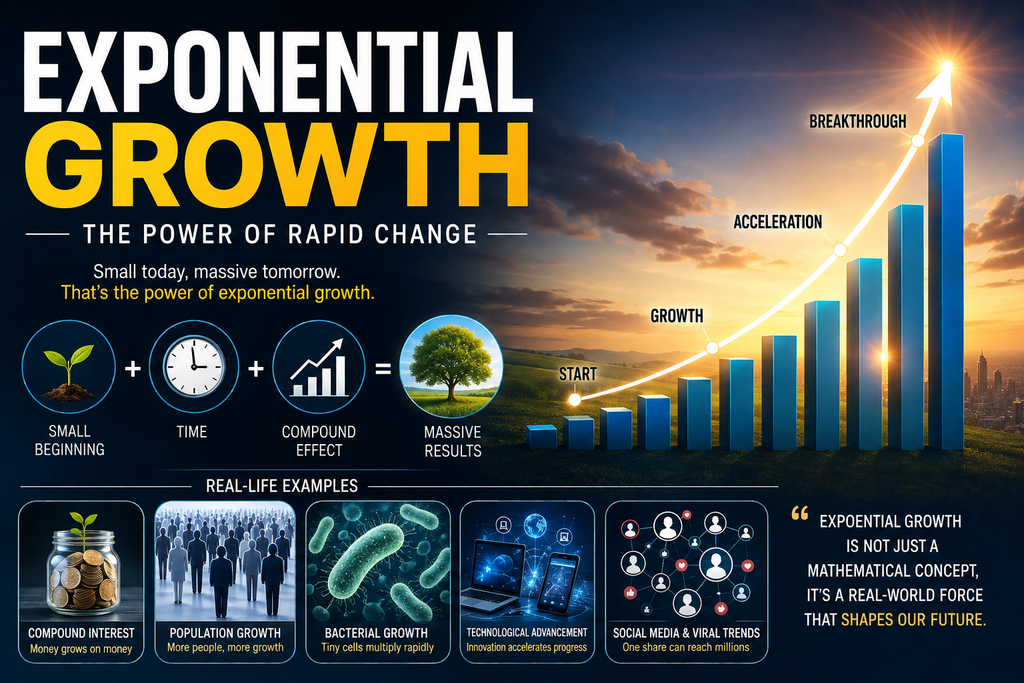
What Does Exponential Growth Actually Mean?
A simple definition
Exponential growth happens when a quantity increases by the same percentage or proportion during equal periods of time. Because each increase is calculated from the new, larger amount, the actual number added becomes progressively bigger.
Imagine you have one dollar and it doubles every day. On the first day, you have $1. The next day, you have $2. Then $4, $8, $16, and so on.
At first, the change looks almost insignificant. But after enough repetitions, the numbers become enormous.
This is why the pattern can be difficult to understand intuitively. Human beings are generally better at thinking about steady, predictable increases than repeated percentage changes.
A useful analogy
Think of a snowball rolling down a snowy hill. At the beginning, it is tiny and gathers only a little snow. As it becomes larger, however, it has more surface area and can collect more snow with every turn. Eventually, the amount it gains during each turn is much greater than what it gained at the beginning.
That is the basic idea behind this mathematical pattern.
Linear Growth vs. Exponential Growth
One of the easiest ways to understand this concept is to compare it with linear growth.
Suppose you receive $100 every month. After one month, you have $100. After two months, you have $200. After three months, you have $300. The increase is always $100.
That is linear growth.
Now imagine that instead your money increases by 10% every month. If you start with $100, the first month gives you $10, bringing the total to $110. The next 10% is calculated from $110, so you gain $11. Your total becomes $121.
The following increase is $12.10, giving you $133.10.
Notice what happened. The percentage remained the same, but the amount added became larger.
| Period | Linear increase | 10% repeated increase |
|---|---|---|
| Start | $100 | $100 |
| 1 | $200 | $110 |
| 2 | $300 | $121 |
| 3 | $400 | $133.10 |
| 4 | $500 | $146.41 |
| 5 | $600 | $161.05 |
| 10 | $1,100 | $259.37 |
The difference becomes increasingly noticeable as more periods pass.
This is one reason people sometimes underestimate long-term percentage-based change. A small rate may appear harmless over a short period but become significant when repeated many times.
The Mathematics Behind the Pattern
You do not need to be a mathematician to understand the basic formula.
A common expression is:
Final amount = Starting amount × (1 + growth rate)ᵗ
Here, the growth rate is written as a decimal, while t represents the number of periods.
For example, suppose a population starts at 1,000 and grows by 5% each year.
After one year:
1,000 × 1.05 = 1,050
After two years:
1,000 × 1.05² = 1,102.50
After ten years:
1,000 × 1.05¹⁰ ≈ 1,629
The population has not simply increased by 500. Each year’s increase builds upon the previous year’s total.
The important feature is repetition
The formula itself is less important than the idea behind it. Each cycle uses the result of the previous cycle as its new starting point.
That creates a powerful feedback effect.
A 5% increase does not remain a fixed number. Five percent of 1,000 is $50, but five percent of 1,500 is $75. The percentage is unchanged while the numerical increase becomes larger.
Why Small Changes Can Become Huge
This is perhaps the most important lesson.
Suppose something increases by only 2% per period. Two percent sounds small. But repeated over a long period, it can produce a substantial difference.
For example, consider a quantity that starts at 100 and grows by 2% repeatedly.
After one period, it becomes 102.
After five periods, it is approximately 110.41.
After ten periods, it is approximately 121.90.
After twenty periods, it reaches approximately 148.59.
After thirty-five periods, it is close to 200.
In other words, a relatively modest rate can eventually double a quantity.
This principle appears frequently in compound interest, where returns can generate additional returns. The same basic mechanism explains why early contributions to long-term savings can be valuable.
The lesson is not that every 2% increase will automatically become enormous. Time, consistency, and the conditions surrounding the growth all matter. But repeated percentage changes can create results that are much larger than we might expect.
Real-World Examples Around Us
This idea is not limited to classroom exercises. It appears in many areas of life.
Finance and investing
Compound interest is one of the most familiar examples. When interest remains invested, future returns can be calculated on both the original amount and previous earnings.
This is why people often describe compound interest as “earning returns on returns.”
Starting early can make a major difference because the money has more time to experience repeated growth.
Population
If a population has a consistent birth rate and other conditions remain relatively stable, its size can follow an exponential pattern for a period of time.
However, real populations rarely continue growing indefinitely at a constant rate. Food availability, disease, migration, housing, environmental limits, and other factors eventually influence the result.
Bacteria
Some microorganisms reproduce very quickly under favorable conditions. If one organism divides into two, and those two divide again, the number can increase rapidly.
What begins as a small group can become a large population after repeated generations.
Technology
Technological development has sometimes followed patterns that resemble exponential improvement. Computing power, data availability, digital connectivity, and other technologies can experience rapid increases over particular periods.
However, technological progress is not always perfectly exponential. Physical limits, costs, engineering challenges, and market conditions can slow it down.
Social media
Online sharing can create another useful example. One person shares content with several people, some of whom share it again. If each stage reaches more people than the previous one, exposure can expand very quickly.
That does not mean every post will become viral. Most do not. But the underlying network structure can create rapid expansion when conditions are favorable.
Compound Interest and Personal Finance
Few everyday examples demonstrate the power of repeated growth as clearly as personal finance.
Imagine putting money into an account that earns a return and leaving the earnings invested. In the beginning, the gains may appear small.
Suppose you have $1,000 and receive a 5% annual return. Your first year’s gain is $50.
The following year, however, the calculation is based on $1,050 rather than the original $1,000. The gain is therefore $52.50.
Over many years, the difference can become meaningful.
Time can be more important than people realize
This is why starting to save early can be powerful. Someone who starts with a modest amount at a young age may have more opportunity to benefit from repeated compounding than someone who starts much later with a larger initial contribution.
Of course, investment returns are not guaranteed. Real financial products involve fees, taxes, changing rates, inflation, and risk. The mathematical model is useful for understanding the mechanism, but real-world outcomes can differ considerably.
The same principle can work in reverse with debt.
If interest is repeatedly added to an unpaid balance, the amount owed can increase significantly. Credit cards, loans, and other financial obligations therefore deserve careful attention.
Business, Innovation, and the Network Effect
Businesses can also experience rapid expansion when one successful activity creates opportunities for additional growth.
Imagine a small online platform with 1,000 users. If satisfied users invite other people, the user base may increase quickly. As the platform becomes larger, it can become more attractive to new users.
This is sometimes connected to a network effect.
A messaging service, for example, may be more useful when your friends, family, or colleagues are already using it. Each new participant can potentially make the service more valuable to others.
Businesses can also reinvest revenue into marketing, research, equipment, employees, or product development. If those investments produce additional revenue, that revenue can finance further expansion.
But there is an important warning.
Real businesses do not grow forever.
Markets become crowded. Customers have limited budgets. Competition increases. Production costs rise. Management becomes more complicated. Regulations can change. A company may eventually move from rapid expansion to slower growth.
Therefore, an exponential model can describe an early stage without accurately describing the entire life of a business.
Population, Disease, and Natural Systems
Natural systems provide some of the most interesting examples.
When a population has abundant resources and few restrictions, its numbers can increase rapidly. Each generation creates the possibility of another generation, which can create a multiplying effect.
Disease transmission can also produce rapid increases under certain conditions.
Imagine one infected person passing an illness to several others. If each newly infected person then infects several more, the number of cases can rise rapidly during the early phase of an outbreak.
However, this pattern cannot continue forever.
As more people become infected, susceptible individuals may become harder to find. Public health measures can reduce transmission. Immunity can increase. Behavior can change. Seasonal factors and other conditions can also influence transmission.
This leads to an important concept: exponential growth is often temporary in real systems.
A mathematical model may show explosive early growth, but the real world usually introduces limits.
The Limits: Why Nothing Grows Forever
If you draw an ideal mathematical curve, it can continue upward indefinitely.
Real life does not work that way.
Every physical and social system has constraints.
A population needs food, water, shelter, and space. A company needs customers and resources. A forest needs sunlight and nutrients. A social trend needs people willing to participate.
Eventually, some limiting factor becomes important.
This can transform rapid growth into logistic growth, where expansion slows as a system approaches a practical limit.
Imagine a small pond that can support only a certain number of fish. At first, the fish population may grow quickly because food and space are plentiful. As the population becomes larger, competition increases. Eventually, the environment cannot comfortably support unlimited additional fish.
The growth curve begins to flatten.
Understanding this distinction prevents one of the most common mistakes: assuming that a rapidly increasing quantity will continue increasing at the same rate forever.
Why Humans Often Misjudge Rapid Growth
Our intuition is not naturally good at handling repeated multiplication.
Suppose someone says, “The number increases by 10% every year.”
Many people imagine a steady addition.
But percentage-based growth works differently. Each increase changes the base from which the next increase is calculated.
This is why tables and graphs can be so useful.
A quantity might appear almost flat during its early stages. Then the curve begins bending upward more dramatically.
The importance of doubling time
Another useful way to think about rapid growth is doubling time: how long it takes for a quantity to become twice its original size.
A common approximation is the Rule of 70. Divide 70 by the percentage growth rate to estimate the number of periods required for doubling.
For example:
- 10% growth → roughly 7 periods
- 5% growth → roughly 14 periods
- 2% growth → roughly 35 periods
This is only an approximation, but it provides an easy mental shortcut.
It also demonstrates why even a seemingly modest rate can become important over time.
How to Recognize This Pattern in Everyday Life
You can identify this type of growth by asking a few simple questions.
Is the increase based on the current amount?
If yes, there may be a multiplying effect.
Does the same percentage repeat?
Repeated percentage changes are a strong clue.
Does the amount added become larger over time?
If each period adds more than the previous period, the process may be accelerating.
Is there a feedback mechanism?
When the results of one stage create the starting point for the next, growth can accelerate.
For example, money earns returns, which become part of the balance. That larger balance then earns additional returns.
Similarly, users invite users, who invite more users.
The common thread is that the system’s current size influences its future increase.
The Positive and Negative Sides of Rapid Growth
Rapid growth is not automatically good or bad.
Its effect depends on what is growing.
When savings increase, rapid compounding can be beneficial.
When a business gains customers, rapid expansion may create jobs and opportunities.
When useful technology spreads, society may gain access to better tools and services.
But rapid growth can also create problems.
Debt can become difficult to manage. Pollution can increase. Natural resources can be consumed faster than they are replaced. Misinformation can spread rapidly online. Infrastructure can struggle to keep pace with population increases.
This is why understanding the pattern matters.
It allows us to recognize both opportunity and risk.
Rather than asking only, “How fast is this growing?” we should also ask, “What happens if this continues?”
That second question often leads to much better decisions.
How to Use This Knowledge in Everyday Decisions
You do not need advanced mathematics to apply these ideas.
If you are considering a financial decision, look at how interest compounds over time rather than focusing only on the first year’s result.
If you are building a business, consider whether your growth depends on constantly finding new customers or whether existing customers can help generate additional demand.
If you are studying a population or environmental issue, ask whether the available resources can support continued expansion.
If you see a statistic increasing rapidly, check whether it is growing by a fixed amount or a percentage.
Most importantly, think about time.
A small difference today can become a large difference after repeated cycles.
This applies to positive habits too. Reading a few pages every day, saving a small amount regularly, practicing a skill, or exercising consistently may seem insignificant on an individual day. Over months and years, however, repeated actions can produce substantial results.
Not every personal improvement follows a mathematical exponential curve, but the underlying lesson remains powerful: repeated small changes can accumulate.
Conclusion
Exponential growth helps explain why certain changes begin quietly and later become surprisingly large. Its central idea is simple: when increases are repeatedly based on the current amount, the amount added can become progressively larger.
We can see this principle in finance, technology, populations, business, biology, and digital networks. At the same time, real-world systems rarely grow without limits. Resources, competition, physical constraints, and changing conditions eventually influence the outcome.
The most valuable lesson is therefore not simply how to calculate a rapidly rising number. It is learning to recognize the pattern, understand the role of time, and think carefully about what may happen when small changes are repeated again and again.
Once you understand that idea, many seemingly surprising changes in the world become much easier to understand.
Frequently Asked Questions
1. What is exponential growth in simple words?
It is a pattern where a quantity increases by a repeated percentage or proportion. Because every new increase is based on the larger amount created previously, the actual amount added tends to become larger over time.
2. What is the difference between exponential and linear growth?
Linear growth adds roughly the same amount during each period. Exponential growth repeatedly multiplies the existing amount by a particular factor or percentage. Linear change tends to form a straight line, while exponential change can produce an increasingly steep curve.
3. Why is exponential growth so powerful?
Its strength comes from repetition. Each increase becomes part of the base for the next increase. Over many cycles, even a relatively small percentage can produce a large overall change.
4. Does exponential growth continue forever?
Usually not in the real world. Physical resources, financial limitations, competition, market size, environmental conditions, and other constraints eventually slow growth. A system may show rapid expansion initially and then move toward a more stable level.
5. Where can I see exponential growth in everyday life?
Common examples include compound interest, certain forms of population expansion, rapidly reproducing microorganisms, viral online sharing, and some technological developments. Not every example follows a perfect mathematical model, but many demonstrate the same basic principle of repeated percentage-based change.