



The question “Are Elmer and Shirley Heinrich still alive?” often appears in searches about the Heinrich family and their connection to a notable historical story. Because information about people from earlier generations can be scattered across newspaper archives, family records, biographies, and public databases, it is important to separate documented facts from assumptions.
When a person lived many decades ago, determining whether they are still living can sometimes feel like putting together a puzzle. One record may provide a birth date, another may mention a marriage, while an obituary or historical archive may provide the final piece. In the case of Elmer and Shirley Heinrich, understanding their identities and the available historical information is essential before drawing conclusions about their present status.
Who Were Elmer and Shirley Heinrich?
Elmer and Shirley Heinrich are names associated with historical family records that have attracted attention from people researching their lives and family background. However, the names themselves are not necessarily unique. That distinction matters because multiple people can share the same first and last names, particularly when records span several generations.
For researchers, identifying the correct Elmer Heinrich and Shirley Heinrich requires looking beyond names alone. Dates, locations, relatives, occupations, marriage records, census information, and newspaper references can all help establish whether records belong to the same individuals.
This is especially important when someone asks whether a person is still alive. A search result showing an individual with a similar name does not automatically prove that the person is the same individual being researched.
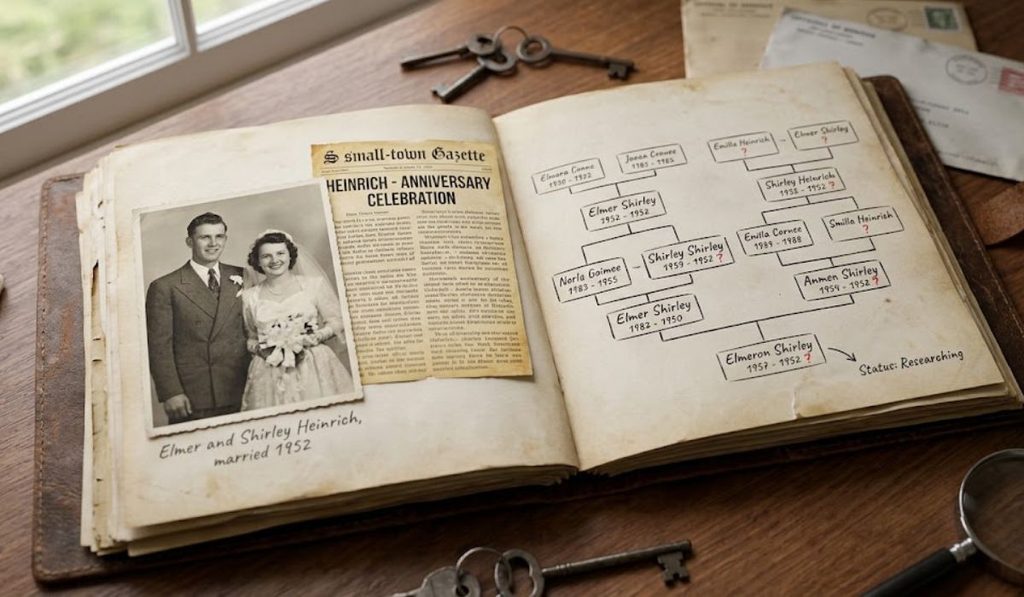
Why identification matters
Imagine looking for someone in a huge library where thousands of books have similar titles. The title gets you into the right section, but it does not necessarily identify the correct book. Genealogical research works in much the same way.
A reliable answer requires connecting several independent details.
The Challenge of Finding Information About Older Individuals
Finding current information about people who lived during the twentieth century can be surprisingly difficult. Modern celebrities and public officials often have regularly updated profiles, but private individuals may disappear from public records after retirement or death.
Elmer and Shirley Heinrich appear to belong to a generation for which many records are available primarily through historical sources rather than modern online profiles.
Birth certificates, marriage announcements, census documents, newspaper archives, cemetery records, Social Security records, and obituaries can all provide clues. Yet these sources are not always digitized, and some databases contain incomplete or conflicting information.
There is another important consideration: privacy.
If a person is or could be a private individual, publicly available information should be treated carefully. A researcher should avoid presenting uncertain information as established fact simply because a database contains a matching name.
What Does “Still Alive” Actually Mean in Historical Research?
The phrase sounds straightforward, but it requires evidence.
If a person has a documented death record, obituary, cemetery record, or another authoritative source, researchers can generally establish that the individual died. If there is no death record, however, that does not automatically mean the person is alive.
This distinction is one of the most common problems in genealogy.
A missing obituary is not proof of continued life. An inactive record is not proof of death. Similarly, an old photograph does not establish someone’s current status.
Researchers therefore use what is sometimes called a “last known evidence” approach. The goal is to identify the most recent reliable record associated with the person and determine whether later records indicate a death.
Elmer Heinrich: What Can Be Established?
Information concerning Elmer Heinrich should be interpreted in the context of the particular family and historical records being discussed.
The name appears in historical and genealogical material, but identifying one individual with complete certainty requires additional information such as a birth year, location, spouse, parents, or children.
That is particularly important because genealogy websites often combine information from multiple contributors. Some entries are carefully sourced, while others may rely on family submissions or older records.
The importance of supporting records
A strong identification normally involves several matching details:
- Full or partial name
- Approximate birth year
- Geographic location
- Spouse or family members
- Employment or military information
- Census records
- Marriage records
- Newspaper references
- Death or burial information
When several of these details agree, confidence in the identification becomes much stronger.
Without those connections, saying definitively that a particular Elmer Heinrich is alive or deceased can be misleading.
Shirley Heinrich and the Family Connection
Shirley Heinrich presents a similar research challenge.
The name Shirley has been widely used across several generations, and Heinrich is a surname found in many regions. Consequently, a name-only search can produce records belonging to unrelated families.
Family relationships are particularly useful in this situation. If a source identifies Shirley as Elmer Heinrich’s spouse or another close relative, researchers can compare the surrounding information with historical documents.
Family records can reveal more than a single document
Suppose one record gives Shirley’s approximate age while another gives her residence. A third record may identify her spouse. When these pieces overlap, they create a much clearer picture.
This is why genealogy is rarely based on one document alone. Instead, researchers build a timeline.
Newspaper Archives and Historical References
Newspapers can be extremely valuable when investigating older generations.
Local newspapers frequently published marriage announcements, anniversary notices, community events, obituaries, family reunions, and milestone birthdays. These seemingly ordinary notices can become important historical evidence many years later.
For Elmer and Shirley Heinrich, newspaper archives could potentially help establish:
- Where they lived
- When they married
- Names of relatives
- Community activities
- Anniversaries
- Retirement information
- Death announcements
However, newspaper evidence should still be evaluated carefully. A newspaper can contain typographical errors, incorrect ages, or incomplete family information.
A useful rule is simple: the more independent records agree, the stronger the conclusion.
Census, Genealogy, and Public Records
Historical census records are another important research tool.
Census documents can place a family in a specific location during a particular year and may provide information about household members, ages, occupations, and relationships.
Genealogy databases can then connect these records with later documents.
But online family trees should not automatically be treated as authoritative. A family tree may contain valuable clues while still having errors. The original record is generally more useful than an unsourced tree.
This distinction matters when investigating whether someone is alive.
A family tree that stops at a particular year does not necessarily mean the person died during that year. It may simply mean nobody has added later information.
Why Online Searches Can Produce Conflicting Answers
Search engines are excellent at finding information quickly, but speed is not the same as accuracy.
A search for Elmer and Shirley Heinrich might produce genealogy websites, old newspaper pages, family trees, social-media profiles, cemetery databases, and unrelated individuals with similar names.
Some sources may say one thing while another appears to say something different.
How should a researcher respond?
The answer is to examine the evidence behind each claim.
Consider the source before accepting the result
A recent official record generally deserves more attention than an unsourced online comment. Likewise, a contemporaneous newspaper obituary can be stronger evidence of death than a modern family-tree entry that simply lists an estimated year.
Researchers should also pay attention to dates.
A record from decades ago can establish that someone was alive at that time, but it cannot by itself establish that the person remains alive today.
What the Available Evidence Can and Cannot Tell Us
One of the most important lessons in historical research is knowing the difference between evidence and inference.
If a reliable record states that Elmer Heinrich died on a particular date, that is evidence of death.
If the most recent record merely shows Elmer living at a certain address many years ago, it establishes that he was alive at that time. It does not establish his present status.
The same principle applies to Shirley.
This distinction may seem obvious, but it becomes especially important when researching older people because many online databases are incomplete.
Absence of evidence is not necessarily evidence of absence.
That principle can be compared to a clock that stopped running. Seeing that it stopped at 3:00 tells you something about the clock, but it does not tell you what time it is now.
Are Elmer and Shirley Heinrich Still Alive Today?
Based on the nature of the historical information associated with these names, it is not appropriate to state definitively that a particular Elmer and Shirley Heinrich are currently alive without reliable, up-to-date records identifying the same individuals.
Likewise, it would be inappropriate to claim that they are deceased solely because they are difficult to locate in modern databases.
For an accurate determination, researchers would ideally need a documented death record, recent public record, obituary, cemetery information, or another reliable source that clearly identifies the individuals in question.
The key issue is identity matching.
There may be multiple people named Elmer Heinrich or Shirley Heinrich. Therefore, a definitive answer requires knowing which couple or family the question refers to.
How Researchers Can Verify Their Status
If you are researching Elmer and Shirley Heinrich for genealogy or historical purposes, there are several practical steps you can take.
Start with the information you already know. Even one additional detail can dramatically narrow the search.
Useful information includes:
- Approximate birth dates
- Marriage date
- City or state
- Names of children
- Parents’ names
- Occupations
- Military service
- Church affiliation
- Previous addresses
- Known relatives
Next, compare multiple records.
A strong research process might look like this:
Step 1: Establish identity.
Determine which Elmer Heinrich and Shirley Heinrich you are researching.
Step 2: Build a timeline.
List known events in chronological order.
Step 3: Search historical records.
Look for census documents, newspapers, marriage records, and directories.
Step 4: Search death-related records.
Check obituaries, cemetery databases, death indexes, and government records where legally available.
Step 5: Compare independent sources.
Make sure the records refer to the same people.
Step 6: Record uncertainty.
If evidence is incomplete, say so rather than filling the gaps with assumptions.
This method is much more dependable than relying on a single search result.
Why Their Story Continues to Attract Interest
Questions about whether historical figures or private individuals are still alive often emerge because people become interested in the people behind a larger story.
A name mentioned in a book, documentary, newspaper report, family history, or online discussion can lead readers to wonder what happened afterward.
What happened to them?
Where did they live?
Did they have children?
When did they die?
Were they alive when a particular historical event occurred?
These questions are natural. They reflect a desire to understand history through individual lives rather than dates and statistics alone.
For many readers, historical research becomes more meaningful when they can connect major events with ordinary people who experienced them.
The Importance of Responsible Genealogical Research
Researching family history can be fascinating, but it also requires responsibility.
A person’s age, family relationships, address, health information, and current status can be sensitive. Researchers should therefore distinguish between information that is genuinely historical and information that could intrude on the privacy of living individuals.
This is especially relevant when dealing with people who were not public figures.
A responsible researcher should:
- Use credible sources.
- Verify names and dates.
- Avoid spreading unconfirmed claims.
- Respect living people’s privacy.
- Distinguish fact from inference.
- Cite original records when possible.
- Correct mistakes when better evidence appears.
Historical research is not simply about finding an answer quickly. It is about finding an answer that can withstand scrutiny.
Conclusion
The question of whether Elmer and Shirley Heinrich are still alive cannot be answered responsibly from names alone. Historical and genealogical research requires matching the correct individuals to reliable records and distinguishing documented facts from assumptions.
If you are researching a specific Elmer and Shirley Heinrich, details such as their location, approximate birth years, relatives, or the historical story in which they appear would make it possible to narrow the investigation considerably.
Their story also illustrates a broader lesson about genealogy: sometimes the most important part of finding an answer is not discovering another search result, but determining whether the information you found actually belongs to the right people.
Frequently Asked Questions
1. Are Elmer and Shirley Heinrich still alive?
There is not enough reliable identifying information to make a definitive current-life-status statement about specific individuals with those names. Additional details are needed to distinguish them from other people with the same names.
2. How can I find out when Elmer Heinrich died?
Search for a death certificate, obituary, cemetery record, newspaper announcement, or other reliable historical document. Confirm that the record matches the correct Elmer Heinrich through age, location, relatives, or other identifying details.
3. How can I find information about Shirley Heinrich?
Genealogy databases, newspaper archives, census records, marriage documents, cemetery databases, and family records can provide useful clues. Multiple sources should be compared before reaching a conclusion.
4. Can an online family tree prove that someone is deceased?
Not necessarily. A family tree can provide useful information, but an unsourced or user-created tree may contain mistakes. A documented death record or obituary is generally stronger evidence.
5. What information would help identify the correct Elmer and Shirley Heinrich?
Their approximate birth years, location, marriage information, names of children or parents, occupation, or the specific historical event connected with them would all help distinguish the correct individuals from others with similar names.